10 May Why does a longer exhale calm you down?
If you’ve never paid much attention to your exhale, you’re in good company. Most of us focus on the inhale — the deep breath we reach for when we’re trying to calm down.
But the exhale is where the actual relaxation happens. Lengthening the exhale activates your vagus nerve, slows your heart rate, and shifts your nervous system out of “activation mode.” It’s probably the single highest-leverage thing you can do for your breathing.
I made a 15-minute guided practice for it, which you’ll find further down.
First, the why.
Why the exhale is your nervous system’s built-in brake
Every breath cycle has two phases.
- The inhale is active. It requires muscle effort — your diaphragm contracts, your ribs lift — and it gently raises your heart rate. The sympathetic nervous system (“fight or flight”) fires a little more strongly here.
- The exhale is meant to be the opposite. Passive. Releasing. Effortless. Your diaphragm relaxes, your lungs deflate, and your heart rate dips. This is your parasympathetic system (“rest and digest”) doing its thing — and the vagus nerve, the long wandering nerve that runs from your brainstem to your gut, is the main pathway it travels through.
This is wired into your physiology—for all of us.
There’s a beautiful mechanism called respiratory sinus arrhythmia (sounds like a problem, it’s actually a sign of a healthy, responsive nervous system!) where your heart rate gently rises on the inhale and gently falls on the exhale.
Inhale: small lift
Exhale: small drop
The longer your exhale, the more time you spend in that parasympathetic dip. Which is why lengthening the exhale = more time with your foot on the brake.
What chronic stress does to your exhale
When we’re stressed, we stop exhaling fully. We cut the exhale short. We hold. We start the next inhale before we’ve finished letting go.
Try this right now:
Exhale halfway, then take your next inhale from there. Notice how it feels. Effortful. Strained. Slightly panicky.
For a lot of people who feel “always on” — anxious, ruminating, jaw clenched, shoulders up around the ears, unable to switch off in the evening — this is what they’ve been doing for years without noticing. Inhaling fully, exhaling partially, inhaling again on top of an already half-full lung.
The cascade looks like this:
Shorter exhales → less parasympathetic activation → the body stays in sustained autonomic arousal → which shows up as anxiety, rumination, muscle tension, hyper-reactivity, and the activated feeling that doesn’t go away even when nothing is technically wrong.
These aren’t separate problems. They’re all expressions of the same thing: your nervous system stuck in a higher gear than it needs to be, with the brake mechanism going unused.
How lengthening the exhale reverses the pattern
Anything that consistently shifts the balance back toward parasympathetic dominance will reduce all of those symptoms, because they share a common root.
Lengthening the exhale is the most direct, mechanical way to do this. You’re not regulating your emotions through your thoughts. You’re using your body’s own braking system, deliberately, by changing the ratio between breath in and breath out.
In the practice below, we move from a 4:4 ratio (4 seconds in, 4 seconds out) progressively out to 4:12 — four in, twelve out. As the exhale lengthens, two things happen at once.
- Vagal tone increases, slowing your heart rate and quieting the stress response.
- Carbon dioxide rises slightly in your bloodstream, which (counterintuitively) improves oxygen delivery to your tissues and contributes to the feeling of calm that comes after.
There’s also something that happens at the very bottom of a full exhale that’s worth paying attention to.
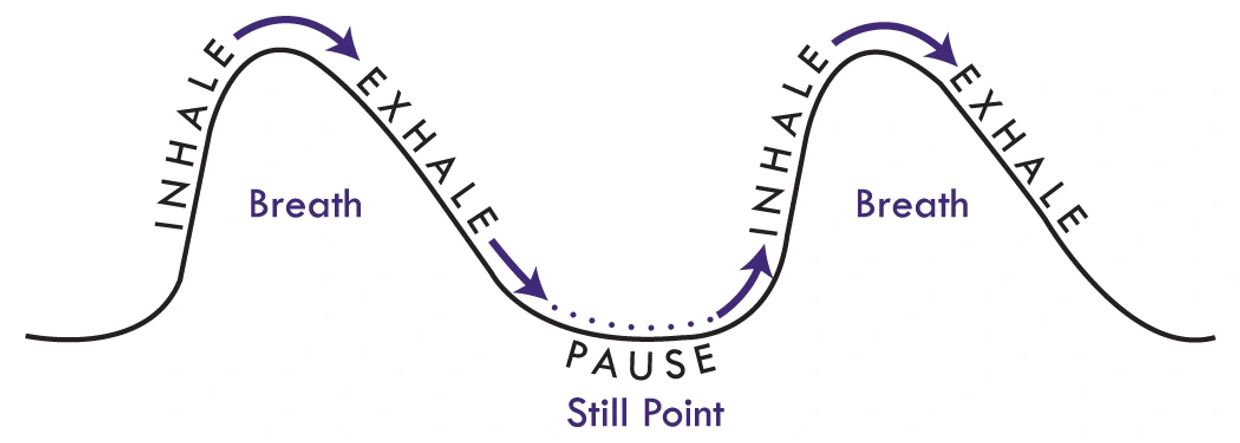
A small pause. Your lungs are empty. Gas exchange is completing. Your body is waiting for the neurological impulse to breathe in again. Some teachers call this the “Still Point.” It might last half a second, it might last five. The exhale is meant to be effortless — you let go until your breath comes to rest, and then you simply wait for the next breath to find you.
That pause is where most of us are uncomfortable. We rush back into the inhale because the stillness feels like something is missing. Practising the exhale is also practising the pause.
(More on this from Dynamic Reintegration.)
Try it — a 15-minute guided practice
Find somewhere quiet to sit. Eyes closed. I’ll keep track of time, so you don’t have to.
We’ll progressively lengthen the exhale from 4 seconds out to 12, using a count and pursed-lip breathing (like you’re breathing out through a straw) to help you go further than you’d manage on your own.
What to expect: as the exhale gets longer (especially past 8 seconds) it gets harder. Carbon dioxide rises. The urge to breathe in shows up earlier than you’d like. That’s the work. Staying with the slight discomfort. Softening into the exhale instead of bracing against it.