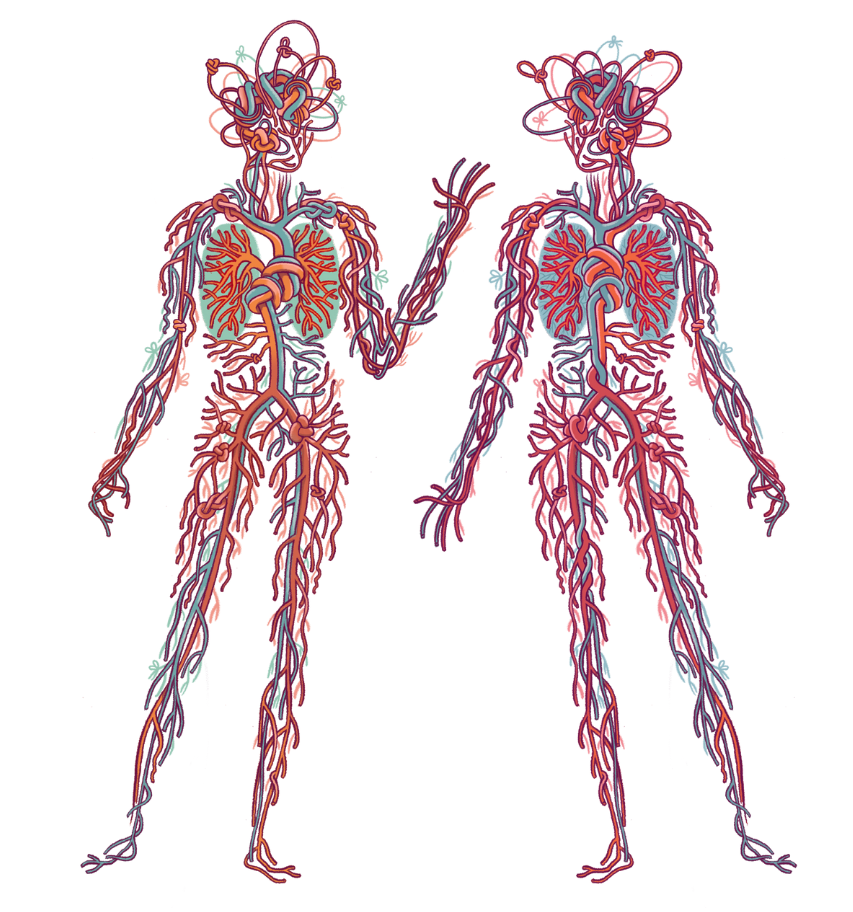
There’s a direct relationship between how much and how quickly we breathe, and the state of our nervous system and thus our physiological and mental health. We assume our body reflexively knows how much air it needs at all times, but seems like that is not the case. Our bodies have adapted to our modern lifestyles, which often involve chronic stress, sedentary habits, unhealthy diets, overheated homes, and lack of fitness. All of that has led to a culture of dysfunctional over-breathing, for some people up to 2 and 3 times the required amount. We breathe too much, too fast and often through the wrong hole. (An incredible book to read is Breath by James Nestor, a journalist who travelled the world to explore what went wrong with our breathing and how to fix it.) Studies that have explored breathing patterns have shown that most people breathe anywhere between 15-30 breaths per minute. These numbers probably don’t mean much until you know that the healthiest and most efficient way of breathing is only 5.5 breath cycles per minute. You can easily measure your own respiration rate if you’d like. Just set a timer for one minute and count the number of breath cycles. One breath cycle...

I feel my back pressed against the chair and the warmth of my feet on the hardwood floor. I focus on the slow rise and fall of my belly, controlling the movement of my diaphragm. Up...

It’s 5:00 PM and you’re just coming out of another long meeting. Your chest feels tight. You take a deep breath. One of those big, reaching breaths that feels like you need to push past some invisible ceiling just to get relief. Sound familiar? That big, gulping breath you need is called a sigh—a breath 2-3x bigger than your normal breath size. Now while occasional sighing is normal (your body actually does it automatically every 5 minutes to sustain lung function), when you're doing it every few minutes… it means something’s off. Chances are, you’ve trained your body to over-breathe. (Well, not you exactly. The world we live in, the jobs we have, the foods we eat,…)     Here’s what’s happening: Every time you take one of those big, relieving sighs, you dump excess carbon dioxide (CO₂) from your system. Wait! Don’t write this off as biochemistry nonsense that’s only relevant in the laboratory. This absolutely matters for your daily experience: CO₂ isn't just waste you exhale. It's the key that unlocks oxygen from your red blood cells. When CO₂ drops too low, oxygen gets stuck in your bloodstream instead of reaching your brain and muscles. That's why you feel air-hungry, foggy, and like nothing you breathe is quite...

It’s funny how often people are skeptical about breathwork. Then as soon as I tell them a few facts about how breathing actually works, their whole attitude changes. They’re surprised. Intrigued. Because even though we breathe all day, every day, most of us know shockingly little about it. Here’s one of my favorite “well… did you know…” When we think of breathing, we typically think of the lungs. And while the lungs are a critical organ, they’re just the site where the gas exchange happens. Oxygen in, carbon dioxide out. But… they’re not what drives your breath. The real engine of your breath is in your brain. Deep in the brainstem, there’s a tiny cluster of neurons called the preBötzinger complex. It’s this group of neurons that generates the rhythm of your breath automatically, moment by moment. Here’s why this is so cool: The brain-breath loop is bi-directional. Your brain influences your breath. Your breath influences your brain. Meaning: Change your breathing pattern, and you change your brain activity. One of the most powerful ways to do that? Slow, nasal breathing. A few things happen when you breathe slowly, in and out through the nose: For one, you’re dialling up your prefrontal cortex. That’s the part of your brain that helps you focus, regulate emotions, and...