17 Feb A 5-week program to rebuild your sleep, energy, and stress resilience through breathwork and nervous system training.
Most sleep advice focuses on what you do at night. Sleep Systems focuses on what you do during the day—because that’s where quality sleep is actually made or broken.
Five weeks of live coaching, science-backed techniques, real data, and a small group to keep you accountable.
Starting on May 4 until June 5, 2026:
- Private onboarding call before the program starts to discuss your sleep challenges, goals, and schedule.
- 5 weeks, two live sessions per week: Teaching on Tuesdays (60 min), breathwork practice + troubleshooting on Fridays (60 min). All sessions recorded.
- Breath and body-based practices throughout: breathwork, nervous system regulation, movement practices, nasal breathing, light and temperature inputs, and non-sleep deep rest. Practised live in sessions, with guided audio recordings from me for your daily practice (15–20 min/day)
- Your own progress tracker to log daily practices and see your improvement week by week.
- You’ll leave with your personalised Sleep Systems Manual: your morning, daytime, and evening routines built around what actually works for your life.
- Small group for real-time coaching, personal feedback, and the kind of accountability that actually works.
- Early bird pricing: £400 / €470 / $550
Who is this for?
You’ve been working for 10–20 years. You’ve built something meaningful: a career, a family, a company, a reputation.
From the outside, things are going well. But under the surface, your sleep has become the thing that’s quietly undermining everything else:
- You can’t switch off. You lie awake replaying the day, running through tomorrow’s to-do list, or just… staring at the ceiling. Your body is exhausted but your brain won’t stop.
- You wake at 4 or 5 am and that’s it. The racing mind kicks in. You lie there for an hour hoping sleep will come back. Some nights, it doesn’t.
- Mornings feel like a battle. You wake groggy, heavy, reaching for coffee before your feet hit the floor. The energy you used to have just isn’t there anymore.
- Your focus and performance are slipping. Concentration is harder. You’re foggier. Tasks that used to feel easy now drain you. And you know it’s because you’re not sleeping.
- You know what you should probably do, but it’s just not sticking. You’ve read the articles. You’ve downloaded the apps. You might have even tried a few things for a week or two. The problem isn’t information. It’s that building new habits without structure and accountability is genuinely hard, especially when you’re already running on empty.
It’s not that you’re not trying hard enough.
It’s that most sleep advice is solving the wrong problem.
Why nothing has worked (yet)
Most sleep advice focuses on what you do at night. But sleep is an output; the result of signals you send your body throughout the entire day.
What signals? That’s where it gets interesting.
Your body runs on three biological systems, each one responding to different inputs during the day.
These three systems are what determine whether you fall asleep easily, sleep deeply, and wake up rested—or don’t:
- Circadian rhythm (your 24-hour body clock) – set primarily by light
- Sleep pressure (your internal tiredness meter) – built through movement and activity
- Autonomic arousal (how switched-on or calm you are) – shaped by stress, breathing, and recovery
When these systems are getting the right inputs during the day (from morning to evening), sleep takes care of itself at night. When they’re not, no amount of sleep hygiene will fix it.
Here’s what I find genuinely exciting about this:
Once you understand how these systems work, you can experiment with them. Adjust your inputs. Observe the shifts in sleep, and by extension in energy, focus, and moods. It’s not about willpower, gadgets, or perfect routines. It’s about learning what your body responds to and designing your day around it.
That’s exactly what this program teaches you to do.
There’s one more thing worth saying here. Motivation to change your sleep habits isn’t just a matter of wanting it badly enough. Motivation is deeply physiological. When you’re sleep-deprived, the parts of your brain responsible for planning, follow-through, and habit building are running on reduced capacity. Trying to build new routines while chronically under-slept is working against your own biology.
This is why the program is built around external structure rather than personal willpower. Two live sessions a week. A small group doing the same experiments alongside you. A coach asking what’s actually getting in the way. The structure holds you while your sleep, and your motivation, catches up.
What results can you expect
These are real shifts reported by clients. Not after months of work, but within weeks of changing their daytime inputs:
- Sleep onset: From 45+ minutes to under 15. No more lying there willing yourself to sleep.
- Night wakings: From 2+ per night to 0–1 — and when they do wake, they fall back asleep within minutes instead of hours.
- Mornings: No more grogginess. No more racing pulse. Actually feeling rested when the alarm goes off.
- Focus: 2–3 hour deep work blocks without burnout. Sharper thinking in meetings. Less brain fog by 3pm.
- Stress capacity: Catching stress at the “tight jaw” stage (before it spirals) and having a 60-second tool to shift it.
- The ripple effect: More patience, more presence, calmer energy. The kind of change other people notice before you do.
How the five weeks work
Most sleep programs hand you a list of techniques and leave you to implement them alone. This one is structured differently.
Each week, we teach the science (just enough to make sense of why something works), then we practise the techniques live in session.
You leave each Tuesday with something specific to experiment with that week. On Fridays we come back together to practise more deeply and troubleshoot what’s actually happening in your life.
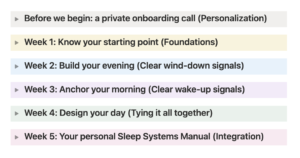
Before we begin: Private Onboarding Call
Before the group starts, we’ll meet 1:1 to talk through your sleep challenges, your goals, and your daily schedule. This way I understand your situation before we dive in, and you’ll hit the ground running from Week 1.
Week 1: Know your starting point (Foundations)
You can’t improve what you haven’t measured. Before we change anything, we build an accurate picture of where you are right now.
- You’ll start a sleep diary to track what’s actually happening: how long it takes to fall asleep, how often you wake, how rested you feel.
- We’ll also look at your breathing patterns: are you a mouth breather? Do you snore? How’s your breathing rate at rest?
- If you snore, we’ll set up tracking with SnoreLab so we have objective data to work with.
- We’ll review your patterns together and set clear, personalized goals for the program. What does success actually look like for you specifically? Sleep onset, maintenance, early waking, energy, emotional regulation?
- We’ll also introduce nasal breathing: why it matters for sleep quality, and how most people are unknowingly over-breathing or mouth breathing at night. You’ll start experimenting with simple tools like nasal strips and mouth taping.
- And we’ll spend real time on something most programs skip entirely: why willpower alone doesn’t fix sleep, how to set up the right environmental and identity structures, and how to approach the next five weeks as a curious experimenter rather than a “bad sleeper.”
By the end of Week 1: You have a clear, honest picture of your current sleep, a personalized goal, and the right mindset to run this as an experiment rather than a test.
Week 2: Build your evening
We start with the evening because it’s where most people struggle most, and because early wins build the momentum you need for everything that follows.
You’ll learn why the nervous system doesn’t automatically switch off at the end of the day, and what it actually needs in order to do so.
- You’ll go into nervous system regulation and the breath practices that shift your body from “alert” to “ready for sleep”: coherent breathing (balancing your inhale and exhale), physiological sighs (the fastest way to down-regulate in a single breath cycle), and extended exhale patterns that activate your parasympathetic nervous system.
- You’ll learn about light as an evening signal (dimming, screen use, and timing) framed not as willpower but as nervous system inputs.
- You’ll practise non-sleep deep rest (NSDR) techniques—body scans, yoga nidra, progressive muscle relaxation—to release physical tension before sleep.
- And you’ll learn what to do when you wake at 4 am and your mind starts racing: gentle, minimal breath tools that help you fall back asleep without making it worse.
By the end of Week 2: You have a working evening routine: one that’s simple enough to actually do, grounded in what your nervous system responds to, and that you’ve already felt working.
Week 3: Anchor your morning
Strong mornings create strong evenings. This week you’ll learn why the first hour of your day is your single highest-leverage sleep input, and build a morning routine around the signals that set your circadian clock, amplify your natural wake response, and create the contrast your body needs to wind down effectively later.
- You’ll learn how light exposure regulates your sleep-wake cycle, why consistent wake times matter more than sleep times, and how to create a clear “wake up” signal for your body.
- On the breath side, you’ll learn how to use energizing breath practices (like breath-holds and short, rhythmic breathing patterns) as morning wake-up amplifiers alongside light.
- We’ll cover cold exposure (practical, accessible versions) as another wake signal that sharpens the contrast between morning alertness and evening calm.
By the end of Week 3: Your day is now bookended. You have both an evening routine and a morning routine. And you’ll start to feel the contrast between them.
Week 4: Design your day
Weeks 2 and 3 bookend your day. This week fills in everything in between. How you move, how you manage stress, how you breathe during your working hours—all of it either feeds into good sleep that night or quietly works against it.
- You’ll learn how adenosine accumulates during waking hours, why movement is one of the most powerful sleep inputs most people underestimate, and how to time activity strategically.
- You’ll explore movement tokens—reframing movement away from gym sessions toward distributed activity across your working day—small, deliberate moments that build sleep pressure without requiring a new fitness routine.
- You’ll add breathwork for real-time focus and stress regulation during work hours: tools for managing stress responses in the moment so they don’t compound and bleed into your evening.
- And you’ll build CO2 tolerance through controlled breath-hold exercises, which improves breathing efficiency and directly supports deeper, more uninterrupted sleep.
By the end of Week 4: All three columns of your personal plan are now in place: evening, morning, and day. A complete first draft of your Sleep Systems day.
Week 5: Your personal Sleep Systems Manual (Integration)
The goal of this program isn’t to create dependence on a 5-week structure.
This final week is about making what you’ve built yours, permanently.
- You’ll compare your current sleep data against your Week 1 baseline and see the shifts clearly.
- You’ll personalise your toolkit: which practices are keepers, which need adapting, which didn’t land and why.
- We’ll work through troubleshooting protocols: what to do on a bad night, what to do after travel or illness, what to do when life gets busy and routines collapse.
- And we’ll close not with a summary of techniques, but with a shift in identity: you are not someone who can’t sleep. You are someone who now understands what sleep needs from you.
By the end of Week 5: You leave with your completed Sleep Systems Manual: your personalized morning routine, day structure, and evening routine, plus your troubleshooting toolkit for when things go off track. Something you built, not something you were handed.
All the program details
Your weekly rhythm
Every week follows the same structure:
- Every Tuesday at 5 pm UK / 12 pm ET: Live teaching (60 min, recorded)
The core of the program. I teach the science behind that week’s focus, and we work through how it applies to your life and schedule. You leave with a clear, concrete focus for the week. - Every Friday at 12.30 pm UK / 7.30 am ET: Breathwork practice + troubleshooting (60 min, recorded)
We open with 30 minutes of guided breathwork, then go into 30 minutes of open troubleshooting: what’s working, what isn’t, what’s getting in the way. By Friday you’ve had several days to try the week’s tools in real life, so the conversation is grounded in actual experience, not hypotheticals. This is where some of the most useful group learning tends to happen. - Daily: Your own practice (20–30 min)
Short, guided protocols you fit into your existing routine: a morning practice, movement throughout the day, and an evening wind-down. Simple enough to actually do. Designed to build, not overwhelm.
(Note: If you’re in a different timezone and the timing is a challenge, let me know. If there’s enough demand I’ll add an additional slot.)
Your support and tools
- Private onboarding call before the program starts. We talk through your challenges, goals, and schedule so I can tailor my guidance from day one
- Your personal habit tracker to log daily practices, track habits, and see your progress visually across the 5 weeks
- Your Sleep Systems Manual — built by you during Week 5, this is your personalized protocol document to take with you after the program
- All recordings and practice guides in an organized digital workspace—lifetime access.
Dates and logistics
- Duration: 5 weeks — May 4 to June 5, 2026
- Live Teaching: on Tuesdays at 5 pm UK / 12 pm ET
- Breathwork + Troubleshooting Sessions: on Fridays at 12.30 pm UK / 7.30 am ET
- Daily practice: 15–20 minutes on your own schedule
- All sessions recorded if you miss a session
(Note: If you’re in a different timezone and the timing is a challenge, let me know. If there’s enough demand I’ll add an additional slot.)
Investment
- Early bird: £400 / €470 / $550
- Full price: £560 / €650 / $750
Note: SnoreLab (for participants who snore) is a separate paid app, not included in the program fee.
Who’s behind this program?
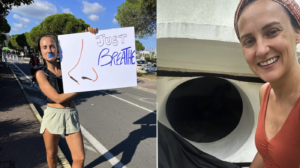
I’m Charlotte Grysolle, a breath and nervous system coach.
These two photos tell you everything about how I think and how I work.
That’s me running a marathon with my mouth taped shut—nose breathing only, for the entire race.
And next to that is me, outside the space where I spent 68 hours in complete darkness. No light, no screens, no human contact, no sense of time whatsoever.
I love doing this kind of weird stuff because I’m obsessed with experimenting with inputs.
What happens when you change one thing? What does the system do? What shifts? Mouth taping, breathwork, light exposure, cold exposure, nervous system practices—I don’t just read about this stuff. I test it on myself constantly. Because I believe you have to feel it in your own body before you can teach it to someone else.
A few years ago, while I was still in a corporate advertising career, I started learning about the nervous system, and seeing my own life through that lens was genuinely life-changing. It removed so much self-criticism and helplessness. Because when you understand how the system operates, you realise that most of what you experience isn’t a character flaw. It’s an output. And outputs change when inputs change.
That shift—from “what’s wrong with me?” to “what does my system need?”—is exactly the shift I want to give you in this program.
I’ve been working with clients for over three years now. Founders, creatives, senior professionals — people come to me with stress, anxiety, burnout, focus issues.
And I kept noticing the same pattern: sleep was always the foundational issue. Always the place we had to start. That’s why I built Sleep Systems.
I teach simple, body-based tools. I explain the science behind them. I hold you accountable to actually practising them. But mostly, I try to make you genuinely curious about your own nervous system—because when that clicks, the motivation takes care of itself.
Here’s what clients say about working with me:
“What I’ve appreciated most is Charlotte’s ability to balance patience with just the right level of toughness — she gently pushed me when I needed it but always ensured I felt supported.”
“The changes have been practical, sustainable, and genuinely life-improving.”
“I used to feel panicked when waking up in the night. That panic is gone, because now I know how to get back to sleep: breath and body techniques.”
“No more morning grogginess, and no more waking up with my heart racing.”
“Charlotte is deeply knowledgeable, action-oriented, and has a wonderful sense of humour. Three qualities that make her coaching both effective and human.”
You can read detailed testimonials here.
Why a group program?
Sleep problems feel private. You don’t usually tell people you’ve been lying awake since 4am, or that you dread bedtime, or that you’re running on fumes. So you assume you’re the only one struggling this much.
You’re not.
One of the most powerful things about this program is realising that other smart, capable people are dealing with the exact same patterns—and watching them shift. When someone in the group shares that they slept through the night for the first time in months, or that their morning grogginess has disappeared, it changes what you believe is possible for yourself.
And then there’s the deeper reason a group works when going it alone hasn’t..
Everything I teach in this program you could probably find somewhere online, in fragments, if you looked hard enough. The information isn’t the hard part. Knowing what to do and actually building it into your life are two completely different things — especially when you’re sleep-deprived, when your motivation and follow-through are physiologically compromised, and when there’s no one checking in on whether you actually tried the practice last Tuesday.
This is what the group gives you:
- Structure that holds you. Two sessions a week, a cohort showing up alongside you, a coach asking how it went. That external scaffolding is what gets practices off the to-do list and into your nervous system.
- Accountability that isn’t awkward. There’s something quietly powerful about knowing that nine other people are running the same experiment this week. You don’t want to come to Friday’s session with nothing to report. That’s not pressure. It’s the kind of gentle social motivation that makes habits stick.
- Learning that multiplies. When someone else in the group asks the question you didn’t know you had, or shares that something clicked for them in a way you hadn’t tried… that’s insight you can’t manufacture alone. With ten people, you’re learning from ten different experiments, not just one.
- There are also things a group gives you that 1:1 can’t. Nervous system work is inherently relational. Practising regulation in the presence of others builds a different kind of skill than practising alone.
You still get individual attention where it matters most: a private onboarding call, personalised feedback on your patterns, and tailored guidance throughout the five weeks.
Ready to join?
I talk to everyone before they join. A quick call to make sure it’s a full-body-yes from both sides. We’ll talk through your sleep challenges, what you’re hoping to change, and whether this cohort is the right fit.
No preparation needed. No pressure. Just a conversation.
Questions?
How is this different from sleep apps, podcasts, or online courses? Apps give you techniques in isolation. This program addresses the three biological systems that determine your sleep quality — progressively, over 5 weeks, with individual feedback on your specific patterns. You’ll practise techniques live, get real-time coaching, and build a complete system rather than collecting disconnected tips.
I’ve already tried everything. Why would this be different? Most approaches focus on what happens at bedtime. This program focuses on what happens during the day—the inputs your body actually responds to. If supplements, apps, and sleep hygiene haven’t created lasting change, it’s likely because the underlying systems haven’t been addressed. That’s what we do here.
What if I can’t make a live session? All sessions are recorded and you’ll have full access. That said, live attendance is where the real value is. The real-time coaching, the group dynamics, and the personalized feedback can’t be fully replicated through a recording.
How much time does the daily practice take? Two live sessions (Tuesday 60 min, Friday 60 min) plus 20–30 minutes of daily practice broken into small moments: 10 minutes in the morning (light + breath), movement throughout the day, and 10–15 minutes in the evening (breath + body awareness). It fits into your existing routine rather than adding to your to-do list. Both sessions are recorded if you can’t attend live.
Do I need special equipment or wearables? No. Just your body and a timer. If you have an Oura ring, Whoop, or similar device, we can use that data — but it’s optional, not required.
I have young kids. My sleep is disrupted no matter what I do. This program isn’t about controlling how many hours you sleep. It’s about protecting the quality of the sleep you do get. When your circadian rhythm, sleep pressure, and nervous system are working well, even disrupted nights are less damaging, and you recover faster. Several of my clients are parents, and the approach is designed to work within real-life constraints — not an ideal schedule.
I’m not a terrible sleeper — I just want to sleep better. Is this still relevant? Yes. Many people join for optimization, not crisis management. If you want deeper sleep, faster recovery, more consistent energy, or better stress resilience, this is exactly the right lever to pull.
What happens after 5 weeks? You’ll have your personalized Sleep Systems Manual, all recordings and resources, and the skills to continue independently. The goal is self-sufficiency — not ongoing dependence. If you want to go deeper after the program, you can move to 1:1 coaching.
Is this therapy? No. This is skill-based coaching focused on nervous system regulation and sleep physiology. It can complement therapy or medical treatment, but doesn’t replace it. If you have a diagnosed sleep disorder, consult your healthcare provider.
What’s the difference between this and your 1:1 coaching? Same science-backed approach. The group program gives you structure, community, and cohort accountability at a lower investment. 1:1 gives you more intensive personalized support and flexible pacing.