23 Jul Chronic stress recovery: why it gets harder as you age
Every so often a client says some version of this: “This used to be easy. Why does it feel so hard now?”
Same workload as five years ago. But now a demanding week costs the whole weekend, not just a tired Friday evening.
Their first assumption is always the same: something’s wrong with them. Maybe they’re not cut out for it anymore.
BUT there’s a simpler explanation, and it’s not psychological. It’s physiological.
Your body has a stress-response system called allostasis — it releases cortisol, adjusts your heart rate, redirects energy, every time demands rise. That’s the system doing exactly what it’s built to do.
The catch: every one of those responses carries a cost. And when there’s no full recovery in between (years of late nights, hard workouts, travel, screens, coffee, alcohol) that cost accumulates. Their system is simply operating under different constraints than it used to. Same ambition, different biology.
I went deeper on the concept of allostatis — including five concrete ways to start lowering it — in the below article.
Chronic stress: why your baseline shifts over time
Something shifts around 10-15 years into a demanding career.
The same week that used to cost you a tired Friday evening now costs you the whole weekend. Two glasses of wine hits differently than it did at 28. You wake up at 4 am and your brain is already running. Things you used to breeze through can now feel overwhelmingly stressful.
You’re still working at a high level, but it seems to ask a lot more effort and energy than it used to.
I’ve noticed that people will often feel like this is a personal failing. Maybe they just can’t handle the pressure? Maybe they’re not cut out for it anymore?
There’s actually a simpler, physiological explanation.
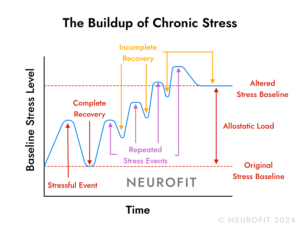
Your body maintains stability under pressure through a process called ‘allostasis’:
- releasing cortisol
- adjusting heart rate
- redirecting energy to where it’s needed
Every time demands rise, the system adapts. That’s what it’s designed to do.
But every stress response carries a cost, and that cost accumulates (especially when there’s no or incomplete recovery.)
Over years of high stress, little sleep, intense exercise, busy social life, coffee, alcohol, travel, news consumption etc etc— the total builds and your stress baseline shifts.
This is called ‘allostatic load’—the cumulative wear on a system that’s been adapting, over and over, without fully recovering between rounds.
This is why strategies that worked perfectly at 28 stop working at 38. Why things that used to feel easy now feel overwhelming.
It is in no way shape or form a personal failing. It’s simply that the system is now operating under a different set of constraints than it was before.
The best thing you can do is learn to work with this system.
You don’t need to be less ambitious or driven. You simply need to treat recovery as seriously as you treat performance.
How to start lowering your allostatic load
Here are a few ways to start managing allostatic load, and lowering your baseline again:
1️⃣ Extend your sleep window by 30-60 mins. Even small increases reduce cortisol, lower blood pressure, and improve cognitive performance. Everything else is harder on an under-recovered system.
2️⃣ Audit what’s adding load (even if it “feels good.”) High-intensity exercise, cold exposure, caffeine, social media. Temporarily reducing one or two doesn’t need to be forever. (I wrote before about the importance of removing things, not just adding)
3️⃣ Add a daily breathing practice of 5-10 mins. Slow, nasal breathing gives the nervous system a genuine recovery signal. No app. No equipment necessary. (Try out this 15-min guided recording exploring your nervous system’s brake: your exhale.)
4️⃣ Build transitions into your day. A walk between meetings, 2 mins of slow breathing before the next task. Without these, activation compounds across the day and never fully clears.
5️⃣ Track your state, not just your output. Sleep quality, energy, tension, clarity. Monitoring these weekly builds awareness of where load is building before it becomes a problem.
With my clients, we use a very simple Visual Analog Scale to track certain parameters week by week. It shows us what to focus on and where we’re making progress.
Breath and nervous system coaching is so much more than learning 2-3 breathwork techniques. I typically don’t start with that until session 3 or even 4, depending on the client. There’s little point in adding a bunch of new techniques to a system that is already overloaded.
So we always start with restoration of the system. Sleep. Allostatic load. Evening wind-down routine. Day-to-day breathing mechanics. Awareness of the body.
Only then do we go into regulation and capacity building.
If any of the above resonates, book a free discovery call where we look at what’s driving your load and whether this type of coaching makes sense for you. Either way, you’ll leave with a clearer picture and practical ideas to start with.