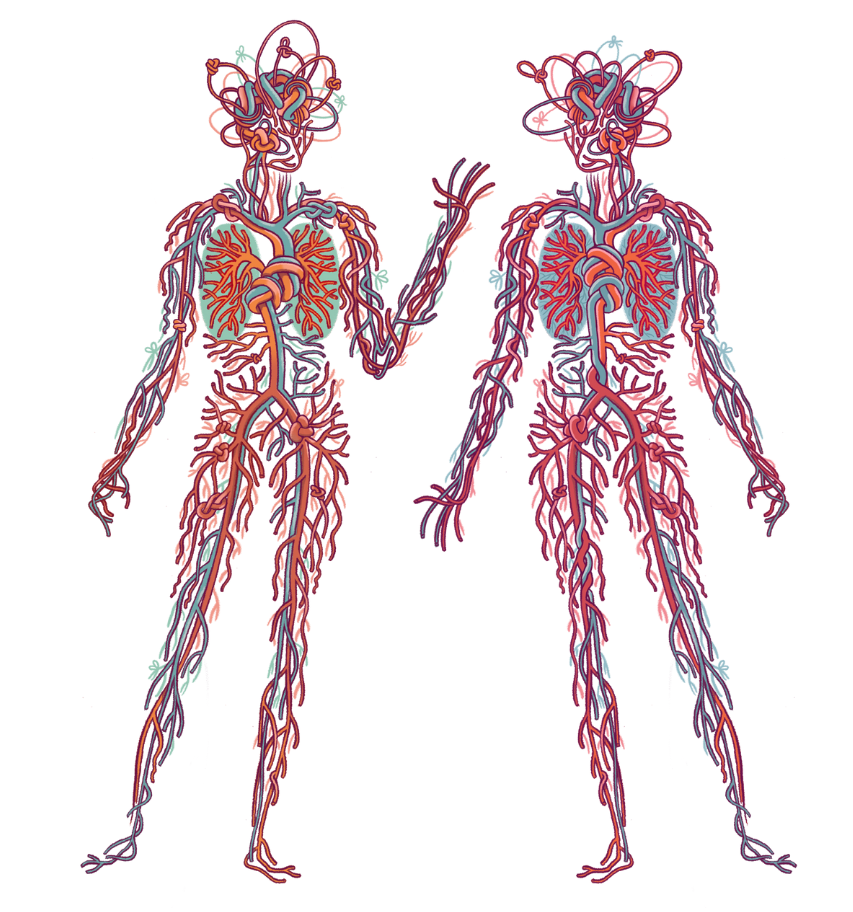
Sometimes you can't step away. You're in the middle of a meeting You've just opened an email you weren't ready for Your kid is melting down and so are you You can feel the stress climbing (chest tightening, breath shortening, mind starting to spiral) and you have maybe ten seconds before you need to respond to whatever's in front of you. This is exactly the kind of moment the one-breath brake is designed for. One full breath cycle — one deep inhale, a brief hold at the top, one long exhale, and a pause at the bottom — can be enough to shift your physiology and help you find some stress relief. I made a short guided practice you'll find further down. But first, what's actually happening in those few seconds. In the last article on lengthening the exhale I talked about training your system through longer daily practice. This is the "deployment" version: how to use that training in the moments you only have a few seconds. Why one breath can shift your physiology There's a temptation to think a single breath can't possibly do anything. If you've ever been told to "take a deep breath" in a moment of stress and felt nothing change, you...

The number 1 thing I work with clients on is this feeling of chronic activation. "Hard to switch off." "Always tense." "My body feels 'on' even when I'm supposed to be relaxing." It shows up in your body: Tight jaw, clenched belly, shallow breathing, that “always on” hum under the surface. It shows up in your attention: Quick to react, hard to slow down, bouncing between tasks without ever feeling done. It shows up in your sleep: Tired but unable to drop in, waking up through the night, or starting the day already depleted. One of the key ideas I explain to them is this: Relaxation is not an on-off switch. Your nervous system doesn't relax just because you sit down on the couch, step away from your screen, or turn off the lights. After months or years of running in overdrive, your nervous system has literally forgotten how to downshift. Your baseline of autonomic arousal has crept up. What now feels "normal" to you is actually a state of chronic sympathetic activation. Think about it: when was the last time you felt truly, deeply relaxed? Not exhausted, not crashed on the couch scrolling your phone, but genuinely at ease in your body? Every muscle loose, every limb heavy, deep...

  If you struggle with low energy, lack of motivation, or feeling stuck in procrastination, you're likely experiencing nervous system dysregulation. This simple breathwork technique helps shift your state from hypoarousal to your optimal Window of Tolerance in under a minute. I keep this Post-It on my computer to remind myself to SHIFT MY STATE. I tend to wallow when I’m feeling flat. To beat myself up for not being productive. To wish I had more drive. Of course I know fully well that wishing and wallowing doesn’t do anything for me. Action does. So I need a physical cue to remind me that focus, energy, motivation are states I need to actively create. The Breath Technique: From Hypoarousal to Energized An easy and quick way to do that, especially when you’re already sitting down behind your computer, is using your breath to generate energy: Take 15 seconds of vigorous, deep breathing: inhale strongly through your nose, exhale with a quick, powerful “ha” or “pah” sound Hold on full lungs for 6-15 seconds Repeat for 2-4 rounds You might feel a bit silly but you’ll quickly get over that once you realize that you’re creating a very rapid physiological shift in your system: Activating sympathetic nervous system, raising...

Just finished my 30 days no caffeine experiment. It was a success (so much so that I’ll largely continue it), and it made me realize something important about nervous system regulation—the skill I work on with people every day. We're great at coming up with tools to “regulate” ourselves: breathing techniques, grounding practices, cold plunges, meditation, movement. And these tools are powerful. But we're terrible at the other half of the equation: subtraction. Regulation isn't just about what we add. It's equally about asking, "What am I doing that consistently throws me off balance?" And then being honest enough to experiment with removing it. This is hard because the things that dysregulate us are often the things we love. Coffee, alcohol, scrolling, Netflix binges. Habits that feel good in the moment but drain us after. It's uncomfortable to admit that. It's uncomfortable to let them go, even temporarily. But that discomfort is exactly where progress lives. (I’ve experienced it firsthand with alcohol, and now with caffeine.) Only then do we get the data that matters: “What does my nervous system feel like without this?” How do you know it’s time to subtract? When the thing has more control over you than you have over it. My coffee experiment For a long time,...

Our visual system is perhaps the strongest lever by which we can shift our state of mind and body. (Andrew Huberman) Soften your gaze for a moment. Without moving your head, guide your eyes in a slow, deliberate circle – as if you're tracing the edge of a clock on the wall. Feel the smoothness of this movement, the subtle stretch as your eyes reach each corner. Let your eyes slowly close halfway, then three-quarters, then open them wide like you've just seen something surprising. You can direct them up toward your eyebrows, down toward your cheeks, or dart them quickly from side to side. Play with these micro-movements. Now focus on one single word on the screen. One single letter. And now expand your visual field, taking in as much of the space around you as possible without moving your head. Notice how you can easily switch between these modes. This conscious play with your eyes is more than just an exercise—it's a rediscovery of a powerful tool you've always had but perhaps never fully explored. These delicate organs that move automatically throughout your day are completely under your conscious control. Each movement sends ripples of information through your nervous system, influencing your entire state of being. How come the eyes...

Box breathing is one of the most popular breathing techniques, because it’s famously used in Navy Seals training to get their nervous system under control, and stay focused and precise during critical operations. It’s a simple technique: It involves taking an inhale, holding your breath at the top, exhaling, and holding your breath again at the bottom. But, there’s one big caveat. Well, there are a few but I’ll start with this one: There is a wrong and a right way to do it. The wrong way is to blindly follow the instructions online. Most guides tell you to do inhale for 4 - hold for 4- exhale for 4 - hold for 4, or 5-5-5-5. The problem is: the duration heavily depends on your individual nervous system. People who are highly stressed or anxious, or who are completely new to breathwork and have dysfunctional breathing patterns (without being aware of this), will really struggle with those durations and push themselves too hard too quickly. It’s like going into the gym for the first time and picking the heaviest weight. The right way to do it… is to first measure your CO2 discard rate, and use that to determine the duration for your box breathing. Here are the instructions...

  "I carefully plan my focus time, but the moment a new idea strikes, my planned work and good intentions… out the window." I was talking to a potential client about this, and I knew exactly what he meant. I’ve spent years battling distractions—not just the obvious ones like social media or emails, but the ones that live inside my own head. The sudden urge to look up a random fact The need to rethink a decision I already made The impulse to start something new because it suddenly feels urgent Every time I try to focus, something else fights for my attention. And it’s not just a bad habit. It’s how my brain is wired. The good news? I’ve largely trained my brain out of this through breathwork. Every single breathwork session is like a mini practice round before the real work. When you can stay focused on your breath, you can stay focused on your task. First you need to understand the basic role of dopamine Your brain’s dopamine system is not about pleasure. It’s about wanting. Dopamine is what makes you crave and chase things—ideas, distractions, novelty. It’s what gives you the urge to check your phone, even when you just put it down. It’s what...