15 Jan What a three-day darkness retreat taught me about fear, my body, and my mind
I spent three days in total darkness on the island of Koh Phangan, Thailand. In this piece, I share what that experience was like—the moments of ease and discomfort, what came up when there was nothing to distract me, and what I’m taking forward from it.
Night 1: Entering total darkness
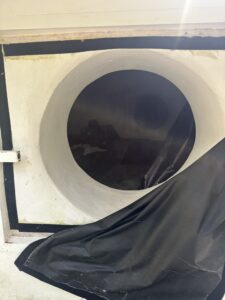
K., the retreat lady, quickly showed me around the sealed earth dome, —“Here’s how you turn on the air ventilation system, do that after every breakfast and dinner, when the air outside is cool. Here’s the shower. Here’s how you can communicate with us. Any questions?”—and then, she was gone.
I stood in the middle of the dome, with a small torch in my hands. K. had told me to use the light to get my bearings and organize my stuff, and to turn off whenever I felt ready.
Those first moments felt incredibly strange. I had just come off a 3-day boat trip with friends, a final wild night in our favorite restaurant in Phuket, and suddenly I was here, alone in this bare cell-like room. My friend, Ben, was in the hut next to me, but everything went so quickly and we did not have a chance to give each other a proper hug and a “good luck!”. Before I knew it, he was in his dome and I was in mine.
I think I had expected a bit more fuss. A moment to mark the transition. K. and her partner S. have been running these dark retreats for over fifteen years, and I imagine that, for them, this is all very ordinary. A practical exchange. Routine. Perhaps they’ve forgotten how big this moment can feel when it’s your first time. Or perhaps this is deliberate, to not build too much tension.
Either way, there I was, in the middle of the dome, taking in the bare walls, the mattress on the floor, my two backpacks. I felt a small but unmistakable surge of panic.
“What the hell have I put myself into?”
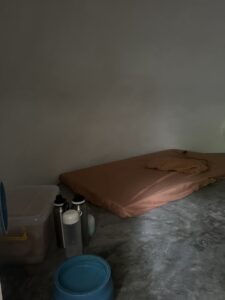
I hesitated with my thumb on the torch. Turning it off felt like crossing a line. But at the same time, standing there looking at the emptiness of the room in the faint light felt worse. So I didn’t draw it out. I clicked the torch off.
I knew dinner should arrive within the hour, so I lowered myself onto the meditation pillow and waited. My body felt heavy with exhaustion, that thick, end-of-a-trip tiredness, but I didn’t dare lie down fully. I was afraid I’d fall into a deep sleep and miss the food.
K. had explained the food system: two knocks on the dome door, then the soft sounds of a tube opening—a small enclosed passage connecting the outside to the inside. I would open it on my end, take the food, and slide the empty container back when I was done. As long as we didn’t open the tube at the same time, no light would enter the dome. And if I needed anything, I could leave a note, scribbled blindly on a piece of paper, in the tube. The whole exchange would be wordless.
So for the first hour, I just sat there on the corner of the mattress, hugging my knees. My body folded in on itself, making itself smaller. I stayed very still, listening intently for the first knock.
There was nothing to look at. No shadows, no gradients, no variation at all. Just one continuous, uninterrupted field of darkness. And when I say darkness, I mean pitch-black darkness. I lifted my hand a few centimetres from my face and saw nothing. No outline. No shift in shade. No faint contrast at all.
I wasn’t particularly stressed or scared. More… blank. Zoned out in a way that felt neither pleasant nor unpleasant. I don’t think I had fully grasped yet what I had committed to. My body was just sitting there, breathing, adjusting, slowly learning what it meant to see nothing at all.
Then, two loud knocks. The sound of the tube being opened. A shuffle, the sound of the tube being closed, and then silence. I crawled over on hands and knees, opened the tube, and patted around in the dark until I found the container, warm to the touch.
My first meal in the dark. For that alone, this was a worthwhile experience. Using my fingers to get a sense of the shape of the plate. A type of Bento Box. Rice. Roasted veggies. Courgette and carrots. Dahl. I was starving and ate extremely quickly. I made a mental note to eat more slowly next time. That’s part of why I wanted to do this in the first place. To take my time. To notice what I’m doing. To use my other senses.
I put the empty tray back in the tube, crawled to the mattress, and fell into a deep, heavy sleep.
Day 1: The body adjusting to the dark
I slept all the way through the night, and woke up from the knocking on the door. Breakfast time.
I wanted to bring a bit of routine into the day, despite the darkness, so I started with a shower. I felt my way into the small, separate bathroom, one hand sliding along the walls, mapping the space by touch.
I had placed everything deliberately. Soap on the ledge. Toothpaste and toothbrush just to the right of it. Toilet paper all the way to the right. Each object had its place, and that mattered. In the dark, order becomes essential.
I noticed how satisfying that was. Thinking through where things should live. Mentally rehearsing the sequence—reach here, then here, then here. And how quickly the body adapted. After only a few repetitions, my hands already knew where to go.
After the shower, I brushed my teeth and, feeling fresh and alert, had my breakfast: a plastic container filled with fruit. The textures and sweetness stood out more than usual.
Then I sat down on my meditation pillow and started with some breathwork, followed by a bit of gentle stretching. Slow movements. Long inhales and even longer exhales. Mentally noting “inhale… exhale… inhale… exhale… inhale… exhale…” Trying to fall into a gentle rhythm.
This was one of the main reasons I had signed up for the retreat:
The promise of having long, unhurried, undistracted stretches of time to meditate and breathe.
No schedule. No interruptions. No distractions.
But it didn’t take long before my body started pulling me in another direction. A deep fatigue settled in. Without daylight, clocks, or external stimulation, my nervous system seemed to default to rest. The usual signals that keep us upright and alert (like light, movement, social cues) were gone. No technology to push through the fatigue. No coffee to override the system.
I fell back into a deep sleep and slept straight through lunch. When I eventually woke up, my head felt thick and heavy. My body clearly had a sleep debt to repay, and in the pitch dark, there was nothing to interrupt that process. I decided to just let it happen. No resistance.
Lunch was similar to dinner the night before: rice, dahl, vegetables. Simple and warm. Tasty. This time I ate more slowly. Without being able to see the food, I had to pay attention—using my fingers, noticing texture, temperature, weight. Lifting each bite with a bit of curiosity, trying to figure out what I was eating before it reached my mouth. Making sure I wouldn’t spill anything. Eating became a small, quiet investigation.
I looked around in the dark. The darkness didn’t feel heavy or threatening. It wasn’t scary. I had imagined it would feel dense, enclosing, almost womb-like. But instead, it felt light. Open. Vast. Not pressing in on me, but stretching outward. As if the space around me had expanded rather than closed in. Incredibly difficult to explain in words, but even now, more than a week later, I close my eyes and can drop into that sensation again.
Once lunch was over, I was in for a long stretch of… nothing. And very quickly, my mind started to spin. It felt scattered, jumpy, hard to settle. Almost immediately, it latched onto time.
I noticed myself doing mental calculations on repeat. “Tomorrow one full day. Another night. And then another full day.” Over and over again, the same sequence, as if repeating it might somehow make it more manageable.
It was striking to observe how thin the line was between staying calm and tipping into unease. I could feel that panicked part circling, looking for an opening. And I could sense how little effort it would take to let it take over completely.
I kept reminding myself to “Just stay here. Stay here. Stay here.” Like a mantra, I repeated “Stay here” to myself over and over again as I slowed down my breath.
The panicked part would throw other things at me, trying to get my attention and overpower me.
“Tomorrow night Ben will be gone and you’ll be here all alone. No one will be here when you get out.”
Stay here. Stay here.
“I wish Meryl would be here when I get out. It’s going to feel so bleak.”
Stay here. Stay here.
Each time, I tried to drop the story and come back to something tangible. No thinking ahead, just pure breath and body sensations. Feeling my legs against the mattress. The weight of my body. The steady thump of my heartbeat. The movement of my breath in my chest and belly.
On that first day, whenever I was awake, I needed to do a lot of this self-coaching. There was not a lot of zen meditation. I was either deep asleep, or calming myself down.
That evening, I pretty much slept through dinner. I heard the knock through a haze of deep sleep, but didn’t even touch the food. At some point, I took another shower. Standing there in the dark, I felt a flicker of unease in realizing that I couldn’t just flick a light switch if I wanted to. There was no way to instantly change the environment. That lack of control felt unsettling and quite vulnerable, yet fascinating to observe.
Day 2: Anxious thoughts and inner fears
I slept all the way through to breakfast again, and went through my morning routine. This whole thing is a real exercise in presence and slowness. I needed to move, get dressed, eat, shower slowly. Feeling my way around. I noticed the familiar urge to rush, and had to remind myself to slow down. There’s literally nowhere to get to. So I’d pay attention to the smallest things: the feeling of the seams on my clothes, the sensation of the warm water on my back, the taste of toothpaste, the roughness of the toilet paper. I’ve realized how deeply sensory I am. How much joy I feel when noticing the smallest details in my experience. Having the space to do that slowly, without distraction, felt deeply luxurious.
What also stood out to me that morning was how little fear I actually felt in the dark. By then, I was moving around with a kind of familiarity—crawling around to find my things, going to the bathroom, making my way to and from the yoga mat—all without any real sense of threat.
My mind would still try, of course. It would float up the usual ideas: “Could there be spiders in here? Or mice? Perhaps a snake rolled up under the toilet seat?” The thoughts appeared, but they didn’t stick. There was no bodily response to them. Just passing mental noise.
It was interesting to observe this happening: my mind offering scary scenarios, while my body remained calm and unconcerned. In without any visual input, instinctual fears didn’t automatically come up as I would have expected. If anything, my body seemed to trust the space more than my mind did.
That said, at some point, my attention shifted from imagined external threats to something more internal.
I started feeling unsettled about the fact that I had chosen to do this. What’s wrong with me for signing up for something so “extreme”? Am I self-centered? Am I trying to escape the “real” world? While everyone I know is at home, back at work post holidays, driving kids to school, I am here, by myself, childless, lying in a dark hut like I’m in solitary confinement. (And I paid for this) Seriously, what am I searching for? Why am I always searching?
A steady drip of doubt, comparison, and self-judgment.
Trust yourself, I kept telling myself. “There’s a reason you feel drawn to this. Everything else is fear. Fear of other people’s judgments, fear of not fitting in.”
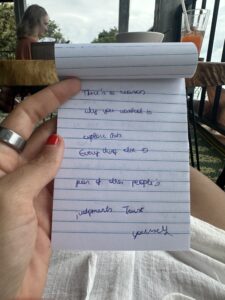
What surprised me was how persistent the thoughts were. When I signed up for this dark retreat, I had pictured myself spending hours meditating and breathing, calm and grounded, floating in some kind of quiet clarity. That wasn’t what was happening at all.
Instead, I was lying there, very still, eyes open despite the darkness, looping the same questions over and over again. Do people think I’m indulgent? Lost? Attention-seeking?
Then the fear widened and landed on my work, my choices, my entire life structure.
Am I making the right decision by working for myself? By giving up a steady paycheck? By no longer being part of a team?
Am I delusional?
Am I really doing this because it leads to more freedom and a better life, or am I just lazy?
Did I leave the rat race because I genuinely believe it’s meaningless, or because I couldn’t handle it?
Wowza! Fun times.
These are the kinds of thoughts that usually show up at five in the morning. The ones that feel very convincing in the dark, but dissolve once daylight arrives and you remember that life is, actually, pretty darn good. Except here, there was no light to perform that reset. No brisk morning walk to bring perspective back online. So I just lay there, observing this relentless, unfiltered stream of anxious thoughts as if listening to a horrible podcast.
I feel slightly embarrassed admitting this.
I would much rather say that I was having profound insights, sitting calmly with my choices, feeling strong and self-assured—independent woman and all. But that wouldn’t be true. What I actually felt was insecure.
What was cool, though, was noticing that I didn’t get lost in the thoughts for too long. Again and again, I redirected my attention to my breath and to physical sensation. The thoughts didn’t stop, but neither did I. Each time I noticed I had been pulled into another loop, I firmly returned to something in my body. The rise and fall of my chest. The air moving through my nose. The pressure of my back against the hard mattress.
Over and over and over again.
And of course, that’s what “presence” is ultimately about. Not a blissful, zen-like state. Not calm or clarity or self-confidence as a constant experience. But this exact movement: noticing the mind has wandered, not engaging with the negative thoughts, and choosing to come back. Again and again. Sometimes hundreds of times in a single hour.
In that sense, I was doing it exactly right. Uncomfortable, absolutely, but also exactly the kind of mind training I believe is so vital.
That afternoon felt long, so long. I was tempted to turn on my phone and just check the time, but I knew that was a dangerous game to play. I might be crushed to learn it was only 3pm, thinking it was 7 pm. So better not to know.
This was becoming a true test of willpower. Not checking the time. Not grabbing my Kindle. Not turning on the torch. Just sitting the darkness, with absolutely no idea how much time left until dinner.
What struck me was how obsessed my mind was with time. Even without a clock, even without any useful information, it kept trying to calculate. “What time could it be now? How long since lunch? How long until dinner? Perhaps dinner’s late?”
Rationally, I knew it didn’t matter. Time was passing whether I tracked it or not. I would get out of the dome when the time was there. Nothing I did would change that. And yet the mind kept reaching for numbers, for markers, for some kind of orientation. I suppose to the brain, knowing the time offers a sense of control and safety.
So that, having no idea of timing, and the relentless darkness, was turning out to be the most difficult part for me. Not the boredom. That was quite easy. I didn’t think about my phone at all, and didn’t miss any of that. It’s really hard to resist the phone when it’s right next to me, but once all of that is completely removed, it felt easy.
In the long, unstructured hours that followed, I found myself returning to my familiar practices.
Lots of body scans. Left part of my body. Big toe, second toe, third toe, fourth toe, little toe. Foot sole. Ankle. Shin. And so on, all the way to the top of my head. Then the right side of my body. Taking my time to feel every single body part.
I also did a lot of high triangle breathing. Deep, slow inhale through the nose. Hold. Long, slow exhale through the mouth. Feeling my ribs and chest fill with air. Feel the pressure as I’m holding. Feel the slow release of the exhale. Over and over again. Guiding in my head. “In… hold… out… In… hold… out…”
Then around 6 pm, Ben was leaving as planned after 48 hours. I could faintly hear their voices outside of my dome. I remember thinking I should turn on my fan so it would drawn out the sounds—I knew it would unsettle me—but I didn’t. I stayed still and listened.
I heard his laugh. His boyfriend asking him something about sunglasses. And then, after a bit of shuffling, silence. He was gone.
I hadn’t expected this to affect me so much. I hadn’t been consciously thinking about Ben’s presence. You’re so deep inside your own small, dark world that the outside barely exists. But the moment he left, I was suddenly acutely aware of how alone I was.
And, once again, my mind got to work.
I suddenly felt extremely vulnerable. In a random location. No phone reception. No light. One single entrance to the dome. Yes, I could leave at any time, but where would I go, in the middle of the night, on an unfamiliar island?
I didn’t actually know these people. They have a key to the dome. Could I really trust them? What if they decided to rob me?! My mind escalated quickly. “Ok, if this happens, I’ll beg them to take me to the nearest ATM and I’ll give them every cent I own.”
There was something almost comical about watching my mind leap to the worst-case scenario, and then immediately start problem-solving it in great detail. I reminded myself that my brain doesn’t care about my happiness in that moment; it only cares about my survival. Its job is to prepare me for every possible danger, however unlikely, even if that preparation makes me feel miserable.
My mind then reached for a memory from years ago—an adventure in Ecuador that, looking back, I had been genuinely lucky to walk away from without anything going wrong. The parallels suddenly felt uncomfortably close. I had placed myself in a similar position again. Remote. Isolated. Dependent on others.
The unease intensified. My body felt alert and tense, even though I was exhausted. I tried to sleep, but I couldn’t. I lay there for what felt like hours, awake in the dark, thoughts circling, my system unable to settle.
At some point I decided there was no need to torture myself. I wasn’t there to punish myself in any way. I absolutely needed to do something that would calm me down, even for a little bit. I searched for my Kindle in my backpack, and read for 2 hours. I didn’t feel bad about “breaking” the darkness. I knew I had to take care of myself in that moment.
That night, I left a note in the tube asking to let me out a few hours earlier the following day. The relentless darkness was starting to weigh on me. I was craving light. Movement. Other human beings. And, very practically, I didn’t want to have to find my way to my next hotel in the dark.
Day 3: Calm, clarity and insight
Waking up on Day 3 felt softer. I moved through my morning routine without much resistance.
Breakfast (again, the juiciest fruits you can imagine.)
Shower.
Stretching.
Breathwork.
On the last day, the parable of the Two Wolves came to mind. It felt very fitting for the experience I’d gone through over the last 2 days.
The story goes like this:
An elder tells a child that inside every person there are two wolves fighting.
- One wolf represents things like fear, anger, envy, resentment, shame, and despair.
- The other wolf represents things like kindness, compassion, courage, patience, gratitude, and hope.
The child asks, “Which wolf wins?”
The elder answers: “The one you feed.”
In the dome, I could feel and see those two wolves very clearly.
One of them was fear and despair. Learned helplessness. Self-pity. Comparison. I could feel it in my body — heaviness, sluggishness, a low, collapsed energy. A furrowed brow. Frequent sighs. Thoughts with a very clear I can’t quality to them.
The other wolf felt entirely different. Lightness. Confidence. Playfulness. Trust. A natural urge to move. A wide smile, bright eyes. A sense of aliveness and perspective. Thoughts that carried a life’s a game, and I can handle this quality.
What struck me was how fine the line was between them. Both were present. Both were real. I could feel them distinctly in my body. I could observe them. And there was a very obvious choice point.
So I began to feed the good wolf deliberately. I brought up sensations of openness in my chest. A sense of expansion. Small sparks of joy and aliveness in my body. Letting those sensations spread, letting them take up more space.
And at the same time, I made an active decision not to feed the other wolf.
Stay here. Stay here.
I was actually settling quite deeply into my meditation when the final knocks on the door came. Part of me felt a flicker of disappointment. “Am I leaving too soon? Should I have stayed?” It felt like my body had only just started to acclimate to the darkness, to the timelessness of it all.
But I also knew that leaving in the light was in that moment more important to me. I don’t need to be in the darkness in order to meditate, or examine my thoughts. I can and will take this practice forward.
The door opened slightly, and S. told me to take my time. I had braced myself for the light to feel jarring, but instead the transition was smooth, almost anticlimactic. He only had a small window in-between meetings to drop me off somewhere, so the ending felt as rushed as the beginning (that one’s on me, since I asked to be “released” earlier.) I took one last look at the dome I spent the last 67 hours in, climbed onto the back of his motorbike, and we were off.
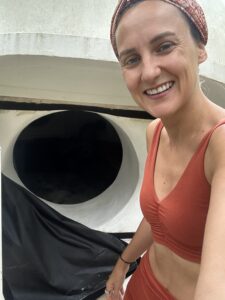
3 insights I’m taking away from this experience
After the dark retreat, I spent a bit more time on the island and then a few days in Bangkok. I took my time to really reflect on the experience, and do this write-up.
Three insights stand out to me.
1. I’m not afraid of stillness or boredom. I’m afraid of judgment and being different.
Stillness itself feels natural to me. Sitting quietly, no phone, feeling my body, following my breath—that part comes easily.
What doesn’t come easily is the social and existential layer: how my life is perceived, not belonging to the dominant storyline that I grew up in and I see around me.
With some distance (and light!), I can see how much of this ties back to a very old, universal human fear:
The fear of being different. Of standing outside the tribe. For most of human history, belonging wasn’t just comforting, it was survival. Safety. Food. Protection. No wonder the nervous system reacts so strongly to choices that place us outside familiar patterns of work, family, and conventional life paths. No wonder curiosity and exploration can feel as selfish, irresponsible, or wrong.
Having an understanding of where these fears come from helps. It doesn’t erase them, but it makes them feel less personal, and more workable.
2. My body is far calmer than my mind
I wasn’t afraid of the dark itself. I wasn’t afraid of physical isolation. My body adapted quickly; finding objects by touch, moving through space, sleeping deeply, regulating itself without much input.
The fear was almost entirely cognitive and emotional. Thought-based. Story-based.
That’s a powerful lesson.
It showed me just how much I can rely on my body, even when my mind is spinning stories. Even in unfamiliar, uncomfortable conditions.
I could feel how much the last few years of breathwork and nervous-system training have shaped this response. The ability to slow my breath. To notice when I was tipping into agitation. To bring myself back through sensation instead of thought. To rest deeply when my system needed rest. To regulate without forcing.
That feels like something I can genuinely trust going forward.
3. Seeing the mind clearly is uncomfortable, and essential
You know the Socrates quote, “The unexamined life is not worth living”?
I wouldn’t go that far because obviously, any life is worth living. But after this experience, I do believe that an unexamined inner life is a life that quietly runs you. Being in the dark showed me how powerful certain fears and thought patterns are for me.
As uncomfortable as it was, I’m grateful that I had the chance to watch these anxious thoughts for so long. To see how persistent they are. How convincing. How quickly they take over when there’s nothing to distract from them.
In everyday life, these patterns are easy to miss. We stay busy. We fill the space. We reach for our phones the moment discomfort arises. Here, there was no way out. I had to look the fears and insecurities squarely in the eye and accept how alive they are for me, no matter how much I’d like to say otherwise.
I think that’s why I’m drawn to experiences like this. They bring the uncomfortable material to the foreground. They make it familiar. And once something is familiar, you’re more likely to notice it when it shows up in daily life.
Because if you don’t see these patterns clearly, they run quietly in the background.
They shape your decisions.
How you feel about yourself.
How you relate to others.
The life you build.
All without ever being questioned.
So while a part of me was fearful of being seen as “weird” or “self-centered”, a bigger part of me is proud for doing this. Despite all the inner turmoil, I know I want to live my life in an experimental, open, and unconventional way. The friction I feel between that part of me, and the part that just wants to blend in and not stand out at all… That’s clearly where the work is for me right now.
Now, the big question people have asked me: would I do it again? 100% yes.
But I would do it differently. I’d prepare more deliberately. Start slowing down before going in, rather than slamming on the brakes once I was already inside. No boat party. No all-nighter. A gentler transition.
That said, I don’t regret it. That last night with friends was worth it. Life isn’t lived in perfect preparation phases. And I guess that contrast, from noise and movement to total stillness, was an important part of the experience itself.
So I’ll definitely do this again in the future. Just not immediately. I want to keep building a steadier meditation practice first. Maybe do a silent meditation retreat. There’s no rush. This doesn’t feel like something to tick off or escalate. The thought of doing this again as a 50-year-old woman, with more life behind me and a different set of fears, actually makes me smile. Maybe it’ll be something like that.
Before going in, I had read that five days is often considered the minimum for a darkness retreat. After having done three, I understand why. Three days is almost not enough to move through the initial layers. Day 1 is mostly sleep and basic adjustment. Day 2 is anxiety, restlessness, and more adjustment. It’s only around Day 3 — and especially beyond — that something starts to settle. I could feel the beginning of that shift just as I was leaving.
And the second big question: would I recommend it to to other people?
Yes, with a caveat!
I would recommend it if you have at least some basic meditation or breathwork practice. It doesn’t have to be extensive. Even a few minutes a day is enough. What matters more is a genuine interest in being still, in turning inward, and facing your fears.